For contractors, trust is everything. Every potential homeowner checks the reviews to see how you handle conflict. A non-response is bad, but an emotional, defensive blast? That can be fatal.
The reality is, a bad review is just a publicly visible customer service test. Pass it by responding strategically and professionally, and you’ll build more long-term trust than several positive but vanilla testimonials. This guide breaks down a bulletproof, five-step framework and shows how AI automation can run the whole process for you, keeping you (and your project managers) on the job site instead of the keyboard.
Why Reputation is the #1 Asset in Construction
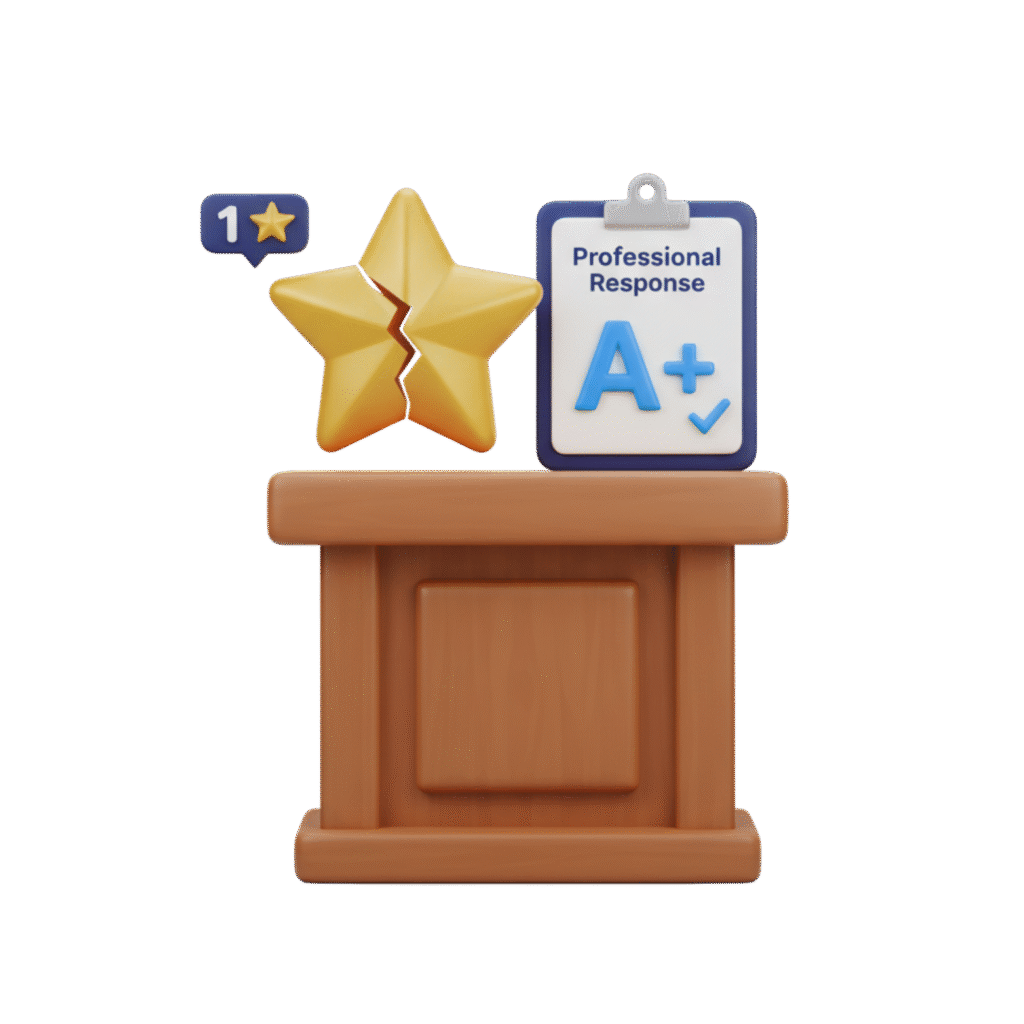
Reputation always matters in business, but even more so for contractors. When a homeowner considers hiring you, they’re considering a massive, long-term financial investment. An added layer of trust is needed because you’ll be working in their home.
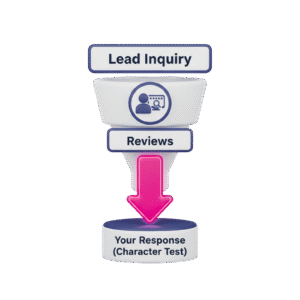
A single negative comment can immediately tank high-value leads because modern buyers use reviews as a critical pre-screening mechanism. They aren’t looking for perfection; they’re looking for accountability.
The Pre-Screening Funnel
Modern homeowners and developers read reviews first and call second.
When they spot a negative comment, they immediately skip to your response. They’re gauging your character under pressure. If they see an unprofessional or absent response, they assume any conflict they might have with you will be handled just as poorly.
Liability vs. Empathy: The Contractor’s Paradox
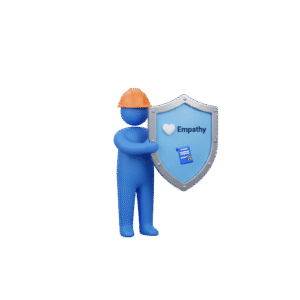
Unlike a standard retail business, contractors have to balance public empathy with legal caution.
Every response must show compassion for the homeowner’s experience while carefully avoiding the admission of fault—especially regarding safety, code violations, or contract breaches.
Your public comment must act as a shield, not a confession.
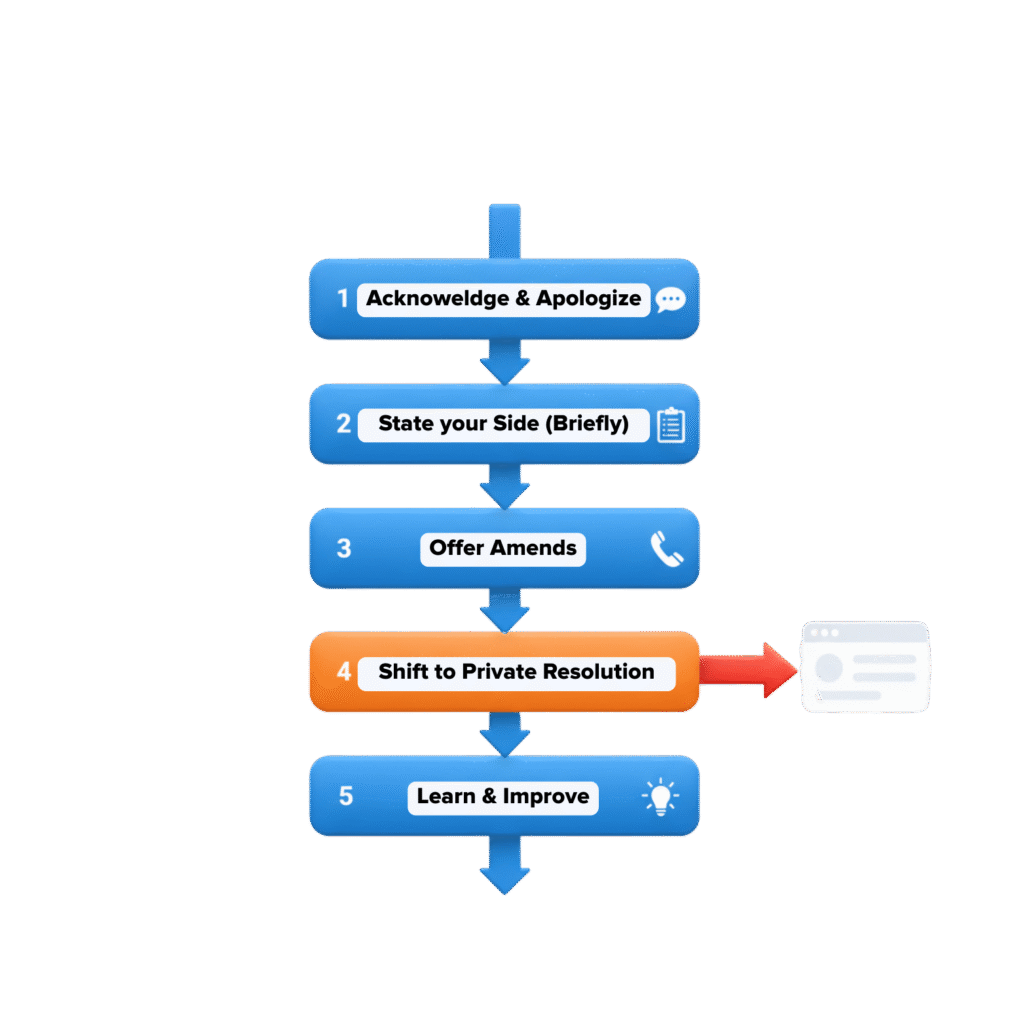
The 5-Step Professional Response Framework
This framework is designed to satisfy the public audience, protect your liability, and instantly shift the conversation to a private channel where real resolution occurs.
Step 1: Public Acknowledgment and Gratitude (Set the Tone)
Your first sentence sets the tone. Be appreciative and professional. Use the reviewer’s name (if public) to show you’re paying attention.
- Example: “Thank you for taking the time to share your feedback. We take all client experiences very seriously.”
- Pro Tip: Reiterate your company name and the industry briefly for SEO purposes (e.g., “As a premier custom home builder in [City/Region], we use feedback like this to continuously improve.”).
Step 2: Apologize for the Experience (Protecting Liability)
This is the most sensitive step. Do not apologize for the specific alleged failure. Apologize for the homeowner’s emotional state or feeling of disappointment.
- Crucial Distinction: Say, “We sincerely apologize that your experience did not meet your expectations and that you felt frustrated by the delay,” NOT “We apologize for mixing up the HVAC system installation.”
- This shows you care without exposing you legally. Acknowledge the emotional challenge of large projects: “We understand that any major construction project can involve stress.”
Step 3: State the Facts Briefly and Objectively (Control the Narrative)
Provide a factual, neutral counterbalance to the complaint. This controls the public narrative for future clients.
- Example: If the homeowner claims non-completion, state: “Our records confirm that the final walk-through was completed and the job was fully delivered on [Date]
per the contractual agreement.” - The Golden Rule: Never air private details or complex financial arrangements. Keep the facts high-level, verifiable, and neutral.
Step 4: Shift to Private Resolution (The Call to Action)
This is the most critical step for reputation repair. You must immediately move the dialogue offline to protect privacy and negotiate resolution without public scrutiny.
- Provide a direct, specific point of contact—not a general support email. This conveys commitment.
- Example: “We have attempted to reach you at the number on file. To ensure this is resolved quickly, please call [Specific Name, e.g., Sarah, Client Relations Manager]
directly so we can discuss and resolve the matter.”
Step 5: Conclude and Reaffirm Brand Values
End the response by stating your ongoing commitment to quality craftsmanship and homeowner satisfaction, leaving the door open for future (private) communication. This is your final message of professionalism to the public.
Autonomous AI Response: Scaling Your Reputation Management
For positive or negative reviews, writing responses manually just doesn’t scale. Every minute you or your project manager spends drafting a response is a minute they’re not spending on site.
AI and automation can solve this instantly, giving you a clear path to scaling your reputation management.
Why Automation is Necessary
- Speed & Consistency: Human responses take time. AI operates 24/7, providing the rapid acknowledgment required by review platforms, which often penalize slow response times.
- Eliminating Context Switching: AI handles the constant administrative drag of monitoring platforms, freeing up project managers (PMs) for their highest-value tasks: job site execution and direct homeowner relationship management.
- Liability Consistency: AI eliminates the emotional, defensive, or legally risky wording that a frustrated human manager might use, ensuring every response adheres perfectly and consistently to the liability-aware 5-Step Framework.
Phase 1: AI-Assisted Triage and Drafting (The Training Period)
Initial adoption requires a Human-in-the-Loop training phase.
Integration is Key. The AI has to be integrated via API with your CRM and PMS (e.g., Buildertrend, Procore, or JobTread). This automatically links the review to the correct job file, homeowner, and dates.
You also need to train the system to pull verifiable facts (e.g., “Date of completion,” “Signed Change Order #”) directly from your project software to ground the response, moving it beyond generic apology templates.
During this phase, PMs manually review and edit every AI-drafted response, effectively training the system on your company’s specific voice and legal risk tolerances.
Phase 2: Autonomous Publishing and Full Workflow Streamlining
Once you’ve found you can trust the AI to respond appropriately, you can allow the AI to perform direct, automated publishing, executing the full 5-step framework without human approval.
As a benefit, the autonomous system automatically triggers the private follow-up email/text (Step 4) to the reviewer, ensuring rapid resolution and moving the discussion off the public platform instantly.
Establishing the “Trust Threshold” for Autonomy
The goal isn’t just to automate responses to negative reviews. It’s to automate safely. You need a structured, quantitative metric to determine when the AI can graduate from drafting to full autonomy. This is the Trust Threshold.
- Quantifying the Threshold: The AI earns the right to publish autonomously only after it achieves and sustains a predefined standard of performance. This typically means consistently hitting a 95% accuracy rating on its drafted responses over a 30-day period—as scored by your PM or legal reviewer. This rating includes adherence to the 5-Step Framework, factual grounding (verified against PMS data), and the absence of any liability-admitting language.
- The AI Confidence Score (Complexity Filtering): Not all negative reviews are created equal. The AI assigns a Confidence Score to each review based on key risk indicators before drafting.
- High Confidence (Low Complexity): Reviews focused on minor, routine issues like site cleanup, miscommunication about material delivery, or basic scheduling complaints. These are the first and easiest candidates to clear for full autonomy.
- Low Confidence (High Complexity): Reviews mentioning specific financial figures, potential structural problems, legal terminology, or insurance claims. These automatically receive a low score, bypassing the autonomous queue and going straight to human review.
- Non-Negotiable Human Oversight: No matter how adept the AI becomes, some reviews are simply too high-stakes to automate. These exceptions are permanently flagged and must remain routed to a human oversight queue:
- Any mention of safety, injury, or severe property damage.
- Any use of language indicating legal action or intent to sue.
- Reviews about major financial discrepancies or code violations.
By setting a clear, data-driven threshold and robust complexity filtering, you ensure that high-risk reviews always get human attention while the majority of routine reputation management runs on autopilot.
Conclusion
It’s unlikely you’ll never get a negative review. But how you respond to negative reviews is a choice.
Leveraging the professional 5-Step Framework is essential, but integrating that framework with an AI-powered system is what makes it scalable and efficient. The speed and consistency provided by automation are crucial for modern construction operations.
Remember: Your public response isn’t just for the disgruntled homeowner. It is a high-visibility advertisement for every future client, showcasing the integrity and efficiency of your process.